

YOUR CART IS EMPTY
Continue shopping



















How to Choose the Best Sunscreen for Combination Skin?
16 Feb 2026
Sunscreen shopping should be simple, but combination skin has a way of making it complicated. One half of your face wants moisture, the other half is already oily before you've even left the house. So you're stuck choosing between a sunscreen that hydrates but greases your T-zone, or one that controls shine but dries your cheeks.
Luckily, you don't have to pick sides. A well-chosen sunscreen can balance both concerns at once. Here's how to find one that protects your skin without creating new problems.
Why Combination Skin Needs a Different Approach
Not every sunscreen works for every skin type, and combination skin sits in a tricky middle ground.
- Oily and dry at the same time: Combination skin means your T-zone produces more oil, while your cheeks and jawline are dry. Oily areas clog up easily, and drier zones get irritated by products that strip moisture. A sunscreen for daily use needs to walk the line between both.
- Most formulas pick a side: Thick, creamy sunscreens sit heavy on oily areas and cause breakouts. Ultra-matte formulas make dry patches look worse. Most options target one extreme or the other, which is why combination skin needs a more specific pick.
-
Weather changes the balance: Summer humidity pushes your T-zone into overdrive, while winter air dries out cheeks further. Your sunscreen may need to adapt, leaning lighter in warm months and more hydrating in cooler ones.
What to Look for in a Sunscreen for Combination Skin?
Once you understand the challenge, choosing gets simpler. A few key qualities separate a sunscreen that works for combination skin from one that doesn't.
Lightweight and Non-Comedogenic Formulas
A gel-based or fluid-textured sunscreen absorbs quickly and sits well on combination skin. Non-comedogenic formulas won't block pores, which is essential when your T-zone is already prone to congestion. An oil-control sunscreen with a non-sticky finish can protect without adding shine.
Broad-Spectrum SPF 50 or Higher
Always go for broad-spectrum protection, which shields against both UVA and UVB rays. SPF 50 PA++++ is a solid standard for everyday wear. UVA rays contribute to premature aging while UVB rays cause sunburn, so coverage against both is non-negotiable.
Skin-Friendly Extras
Some sunscreens go beyond UV protection. Look for added ingredients like:
- Niacinamide: May help control oil production and minimize pore appearance.
- Hyaluronic acid: Provides lightweight hydration without heaviness or greasiness.
- Vitamin E or caffeine: Antioxidants that may help protect skin from environmental stressors like pollution.
- Green tea extract: Known for its soothing properties, which may help calm sensitive or reactive areas.
- Kojic acid or alpha arbutin: May help fade dark spots and even out skin tone over time.
A niacinamide-based sunscreen can balance oil and hydration while keeping skin protected.
Fragrance-Free (Reactive Skin Type)
Combination skin can be reactive in patches, especially around the cheeks and jawline. Fragrance-free or hypoallergenic sunscreens tend to sit better on these areas without triggering redness or irritation. A good rule is, if the scent is strong, the formula probably isn't gentle enough.
What to Avoid in a Combination Skin Friendly Sunscreen?
Knowing what to skip is just as important as knowing what to look for. Watch out for:
Heavy Creams and Thick Formulas
If a sunscreen feels rich and buttery, it's probably designed for dry skin. On combination skin, that formula will likely congest your pores and make your T-zone oilier by midday. Stick to gel, fluid, or spray-based textures. A sunscreen spray with an invisible finish can be a great option for easy, even application.
Alcohol and Synthetic Fragrances
Alcohol-heavy formulas might feel mattifying at first, but they can dehydrate skin over time. When dry zones lose moisture, oily zones may overcompensate by producing even more sebum. Synthetic fragrances can also irritate sensitive areas. Opt for fragrance-free or naturally scented options whenever possible.
How to Apply Sunscreen on Combination Skin?
Even the best sunscreen won't do much if it's applied incorrectly. Follow these steps for full, even protection.
- Step 1: Cleanse and prep. Wash your face with a gentle cleanser. Apply a light moisturizer on drier areas like cheeks and jawline. Skip moisturizer on the T-zone if it already feels hydrated.
- Step 2: Use the right amount. Squeeze out roughly two finger-lengths for your face and neck. A majority of people underapply sunscreen, which significantly cuts protection.
- Step 3: Dot and blend evenly. Place small dots across your forehead, nose, cheeks, and chin. Blend outward using gentle patting motions instead of rubbing.
- Step 4: Let it set before makeup. Wait about 60 seconds before applying primer or makeup. A settled sunscreen layer holds up better and avoids pilling.
-
Step 5: Reapply every two hours. Sunscreen wears off with sweat and touching. A brightening sunscreen that also targets dark spots can make reapplication feel more like a skincare step.
The Bottom Line
Picking a sunscreen for combination skin doesn't have to feel like a compromise. A lightweight, non-comedogenic formula with broad-spectrum SPF 50 and skin-balancing ingredients can protect without tipping your skin toward oily or dry.
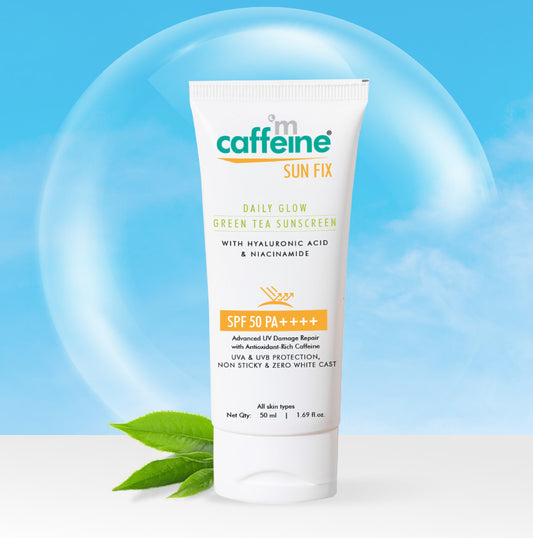
mCaffeine's range of sunscreens, with caffeine, niacinamide, and hydrating actives, offers options built for exactly that balance, so your skin stays protected and comfortable all day.
Frequently Asked Questions
Q. Is gel or cream sunscreen better for combination skin?
Gel-based sunscreens are generally a better fit. They absorb quickly, feel lightweight, and don't add extra shine to oily areas.
Q. How do I stop my sunscreen from making my T-zone oily?
Use a mattifying or oil-control sunscreen on your T-zone. You can also blot with a tissue after application to absorb excess without removing the product.
Q. Should I use different sunscreens on different parts of my face?
You can, but a lightweight, non-comedogenic sunscreen with balanced hydration should work well across your entire face.
Q. Does sunscreen cause breakouts on combination skin?
A sunscreen itself won't cause breakouts, but a thick or pore-clogging formula might. Sticking with gel-based or fluid textures is a much safer bet for breakout-prone skin.
Q. How much SPF is enough for daily use?
SPF 50 PA++++ is a solid choice for everyday protection. Always pair it with reapplication every two hours for best results.

Best Hydrating Body Care Kit for Daily Use in India
20 Aug 2026
mCaffeine Coffee Body Scrub vs Ubtan: What to Choose, When and Why
18 Aug 2026
Top 5 Tan Removal Products in India That Actually Work (2026)
13 Aug 2026

How to Get Even Skin Tone on Your Body: A 4-Week Routine Plan
06 Jun 2026
